

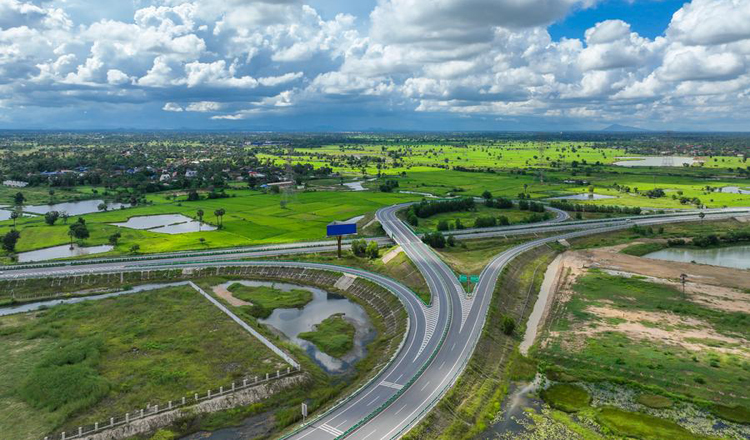

A flagship project under China’s Belt and Road Initiative (BRI), the Phnom Penh–Sihanoukville Expressway is not only a symbol of strengthened Cambodia–China relations but also a powerful engine of socio-economic progress, having already served over 12 million vehicles.
Spanning 187 kilometres, Cambodia’s first high-speed toll road has revolutionised travel between the capital and the coastal hub of Sihanoukville, home to the country’s principal deep-sea port. Officially inaugurated in November 2022, the expressway has dramatically cut travel time and enhanced logistical efficiency.
In a joint interview with Chinese and Cambodian media led by People’s Daily on Monday, Fan Xisheng, General Manager of Cambodian PPSV Expressway Co., Ltd. – the company operating the expressway – highlighted the project’s far-reaching impact on regional connectivity and national development.
“The expressway has opened a new chapter in Cambodia’s infrastructure journey,” Fan said, emphasising its contribution to faster, safer travel and increased trade.
Developed under a build-operate-transfer (BOT) model, the $2 billion project was funded by China Road and Bridge Corporation (CRBC). After a one-month free trial period, it officially opened to motorists on October 1, 2022.
The four-lane highway starts at the western outskirts of Phnom Penh, linking with the city’s ring road and cutting through the provinces of Kandal, Kampong Speu, and Koh Kong before arriving at Sihanoukville.
Covering 187 kilometres, the expressway has been a game-changer for both commercial and everyday transportation. It has drastically reduced travel times for both commuters and goods transportation.
“Before the expressway, it took about six to seven hours to travel from Phnom Penh to Sihanoukville via National Road 4 or 3. Since the expressway opened, that time has been cut in half to around two and a half hours,” Fan noted. This reduction in travel time has provided residents with more flexibility and a higher quality of life.
Beyond offering convenience for travellers, the expressway has delivered significant economic benefits to communities along its route. Fan noted that it has not only simplified travel but also facilitated faster trade and improved the livelihoods of residents.
He explained that farmers can now sell their produce across a wider area, accessing markets that were once unreachable due to distance. Fan also emphasised that the expressway plays a key role in driving regional economic growth.
“The expressway has stimulated economic development along its route. Near every toll station, new industrial parks have sprung up. For example, at the 135 km mark, there is an industrial zone covering more than 1,000 hectares, expected to employ tens of thousands of workers,” he said.
Fan highlighted the broader social and economic impact of the project, noting that the expressway brings not only convenience but also economic prosperity. He pointed out that faster and more reliable transportation has boosted the value of surrounding land, creating numerous opportunities for the local population.
This infrastructure project is seen as a “public-benefit road,” offering improvements in quality of life, reducing costs for businesses, and boosting local economies. It represents a path towards more efficient, sustainable, and prosperous growth for Cambodia’s future, he added.
As of this month, the expressway has accommodated over 12.6 million vehicles, reflecting its high usage and importance to both commercial and private transport.
“Currently, 93.6% of road users express satisfaction with the services we provide,” he said.
Source: Khmer Times
All copyrights to Khmer Times.